
Case Study · Dual Static and Dynamic Calibration
Thirty-Five Minutes of Driving, and One Number Nobody Mentioned
A static phase that passed, a dynamic phase that would not complete, and the speed ceiling that explained why.
Walter Aguilar · US-based Brand Specialist, AirPro Diagnostics
Summary
A 2021 Honda Passport had cleared the static phase of its calibration but would not complete the dynamic phase after thirty-five minutes of driving. Picking the job up at a shift change, AirPro Brand Specialist Walter Aguilar identified a speed ceiling that silently resets the procedure every time it is exceeded, a limit nobody had passed on to the technician.
At a Glance
| Service | Dual Static and Dynamic Calibration |
|---|---|
| Vehicle | 2021 Honda Passport |
| Procedure | Two coordinated phases on the same vehicle: static against a target, then a dynamic drive |
| Presenting problem | Static phase completed; dynamic phase would not complete after roughly 35 minutes of driving |
| AirPro Brand Specialist | Walter Aguilar |
| Call duration | About 11 minutes |
| Context | Job picked up mid-procedure at a shift change |
| Cause identified | The drive had exceeded the procedure’s speed ceiling, resetting it each time |
| Also verified | Windshield identification, warning light behavior, static phase re-shot and passed |
| Outcome | Static confirmed, dynamic relaunched with the complete drive brief |
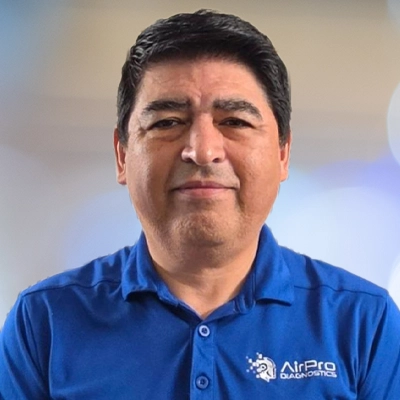
The Brand Specialist on this call
Honda and Acura ADAS Tech
As an ADAS Tech on the Honda/Acura team at AirPro Diagnostics, I bring 34 years of automotive industry experience to the shops I support, including 29 years specializing in Honda and Acura vehicles. I’ve been a member of the AirPro team since June 2021.
My interest in the automotive world started when I was a kid. I always enjoyed taking things apart and putting them back together. In high school, I took both carpentry and automotive classes, but it was automotive that truly stuck with me, and I’ve built my career around it ever since.
What I enjoy most about my role at AirPro is helping people get their work done, whether that’s a simple pre-inspection scan, a calibration, or a diagnostic scan. Every job is a chance to help a shop move forward with confidence.
After nearly three decades with Honda and Acura, I enjoy working on any of their models, but I’m always ready to take on any challenge that comes my way. I don’t have a specific dream car, though a top-of-the-line Mercedes-Benz SUV would certainly be nice.
Picking Up Somebody Else’s Job
I came onto this one at a shift change. A colleague had been working it, his shift ended, and the vehicle was still in the middle of the procedure.
The first thing I did was tell the technician that, and then ask him to walk me through what had already happened.
That is not a formality. When you inherit a job mid-procedure you have two choices: assume the notes tell you everything, or ask the person who has been standing next to the car for the last hour. The notes are good. The person is better, because he knows what he tried that did not work.
What Had Already Happened
Thirty-five minutes with nothing is not a long calibration, it is a calibration that is not running.
He laid it out.
They had done the target request, the static phase, and that had gone through fine. Then they took it out for the driving portion, and he could not get it to complete. So he came back to the shop and set the target up again, thinking he would reshoot the static and try the whole thing fresh.
He had been driving it for about thirty-five minutes.
That is the detail that tells you something is wrong rather than slow. A dynamic phase that is working gives you signs of progress. Thirty-five minutes with nothing is not a long calibration, it is a calibration that is not running.
The Advice Going Around the Shop
He also told me what his manager had suggested, and I want to include it because it is a good example of how shop folklore forms.
The manager had seen this once before. His solution had been to have the Brand Specialist reshoot the target at a different angle, or at a measurement farther out. According to him that worked instantly, and the vehicle completed as soon as they drove it afterward.
That may well be exactly what happened that day. But moving a target farther out is not a fix for a dynamic phase that will not complete. The target is not involved in the dynamic phase at all. Something else changed between those two attempts, and nobody knows what.
The risk with a remedy like that is not that it is harmful. It is that it looks like it works, so it gets repeated, and it stops anybody asking the question that would find the real cause.
Checking the Glass
Before anything else, I asked what windshield was on the vehicle and had him read me the markings off it.
On a camera calibration the glass matters. The camera looks through it, and glass that is not to the manufacturer’s specification can change what it sees. If the windshield had been the problem, I wanted to know before we spent another half hour driving.
It checked out.
Blinking, or Amber
Then I asked the question that separates a system that is working from a system that is faulted: were the lights blinking, or did they come on solid amber?
Blinking means the system is still learning. It is doing what it is supposed to do. Solid or amber means something is wrong.
He told me they had been blinking the whole time he was driving, with the lane keeping indicator appearing intermittently and then going away quickly.
That told me a great deal. The camera was working. The system was trying. It was starting the learn process, getting somewhere, and then losing it. Something was interrupting the procedure rather than preventing it.
Phase One, Again
I had him cycle the ignition (off, a few seconds, back on) and then restart.
Then I ran the static phase. Static pass.
That is phase one of two confirmed, and it is worth being precise about what it means. The static phase being good tells you the camera’s reference against the target is correct. It tells you nothing about whether the dynamic phase will complete. On a vehicle that requires both, you need both, and passing one is not evidence about the other.
Phase Two
Ignition off, back on, engine running. We moved the device out of the way and set up the dynamic.
Dynamic learn mode engaged, and I told him what to watch on the instrument cluster: a small square with a letter in it, and on the other side of that square the lane keeping indicator appearing when the camera is picking up the lines on the road.
That indicator is the progress bar. You want to see it as much as possible. When the system has what it needs, it holds for a few seconds and then all the lights go out. That is completion. Find a safe place to park and call me back.
The Number Nobody Had Mentioned
Every time you go over seventy, it resets.
Then I told him the thing that I think explains his entire afternoon.
Do not go over seventy miles an hour. It will not complete. Every time you go over seventy, it resets. You do not have to stop, just keep it under.
His answer: “He did not tell me that.”
Thirty-five minutes of driving. A system that kept starting to learn and then losing it. A speed ceiling nobody had passed on.
I cannot prove that was the cause, because I was not in the car. But it fits everything he described, and it is the single most common reason a dynamic phase runs and runs without finishing.
Why I Give a Tighter Range
He knew the manufacturer’s window and quoted it back to me: their published range runs from the mid-forties to seventy.
I ask for fifty to sixty-five.
That is deliberate. If I give somebody the full published range and they drive at the top of it, every small variation in traffic pushes them over the ceiling and resets the procedure without telling them. Asking for a band inside the spec means a driver can stop concentrating on the speedometer and concentrate on the road, and the procedure still completes.
The specification is what the vehicle will accept. The range I give is what a person can actually hold while driving in traffic.
Walter’s notes
What I’d Tell Another Shop
- A dynamic phase that runs long is usually a dynamic phase that is resetting. Thirty-five minutes with no progress is not slow. It is not running.
- Exceeding the speed ceiling restarts the procedure silently. Nothing warns you. The system simply begins again, and you drive on believing it is still accumulating.
- Ask for the complete drive brief, including what to avoid. Minimum speed, maximum speed, road type, lane markings. The maximum is the one that gets left out, and it is the one that costs you an afternoon.
- Blinking and amber mean different things. Blinking is a system learning. Amber or solid is a fault. Report which one you are seeing, because it changes the diagnosis completely.
- Passing the static phase tells you nothing about the dynamic phase. On a vehicle that requires both, they are separate requirements that fail for separate reasons.
- The target is not involved in the dynamic phase. If the drive will not complete, moving the target is not the answer, however many times it has seemed to work before.
- Say what you already tried. When a job changes hands, the most valuable thing in the room is the technician who knows what has already failed.
- Drive inside the spec, not at the edge of it. Pick a band with margin on both sides so ordinary traffic does not reset you.
More case studies
Real calls, real vehicles, real results
Case Study: Twenty Attempts, and the Camera Told Us Why
A 360 calibration that failed every time, until the image itself became the measuring instrument.
Case Study: It Passed in the Bay and Failed a Mile Down the Road
A pitch angle that was inside specification but sitting too close to its edge, and what a camera does the moment it sees real lane lines.
Case Study: Three Calibrations, Eight Minutes, and One Correctly Deferred
A Honda Pilot, a steering angle reset, and what a properly sequenced calibration stack looks like.
Be the one-stop shop your customers are looking for
Meet with an AirPro Representative to find the best solution for your business today. Become the standout amongst your competitors.