A hailstorm doesn't just fill your calendar with dent repair work. It also fills your calendar with required ADAS calibration work.
Hail and dent work frequently includes windshield replacement, which means the forward-facing camera must be recalibrated. Roof, pillar, and quarter-panel work sits inches from radar units and camera mounts. Bumper repair and reinstallation can disturb the front radar. These are all OEM-documented calibration requirements, and they follow the vehicle whether the work happens in a shop bay, under a tent, or in a parking lot.
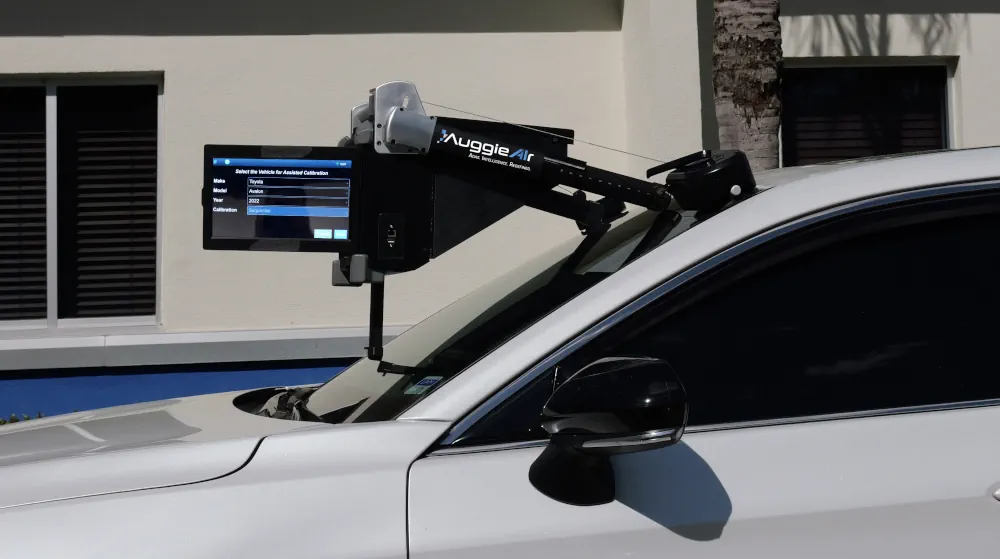
AirPro Diagnostics’ Auggie Air is a fully mobile digital targeting device that mounts to the windshield and renders the target for the forward-facing camera (FFC) calibration to OEM specification, wherever the vehicle is. No specialized bay, no floor targets, no controlled lighting required. Calibrate a vehicle’s FFC with Auggie Air anytime, anywhere, indoors or outdoors.
When the damage is to the roof, pillars, or quarter panels (work that sits inches from radar units and camera mounts) or when bumper repair has disturbed the front radar, the calibration runs through the vehicle’s diagnostic system. An AirPro Diagnostics US-based Brand Specialist can join the session remotely, confirm which systems require recalibration for the specific vehicle, guide the procedure from start to finish, and close out the OEM-required documentation before the vehicle leaves, ensuring a complete and documented repair.
Does your shop perform any of these?
- Hail Damage Repair with Windshield Replacement
Forward-facing camera must be recalibrated after every windshield replacement on ADAS-equipped vehicles - Roof, Pillar, and Quarter-Panel Dent Repair
Camera mounts, brackets, and radar sensors sit within this work zone on most platforms - Bumper Dent Repair or Reinstallation
Front radar units sit at or behind the bumper fascia on most ADAS-equipped vehicles - Minor Collision or Impact Dent Repair
Several OEMs require calibration after any impact near ADAS sensors, regardless of visible damage
If any of the above applies, ADAS calibration requirements apply to that vehicle; keep reading.
ADAS Calibration Triggers
Most ADAS-equipped vehicles built since 2016 mount the forward-facing camera directly to the windshield glass, typically at the top center behind the rearview mirror. That camera is calibrated to aim at a precise point in space relative to the vehicle’s geometry. When the windshield is removed and replaced, the camera is moved. That reinstallation, even when performed correctly, displaces the camera’s aiming reference and requires a recalibration before the ADAS safety systems can perform as designed.
The same principle applies to work near radar units. A front radar mounted at the bumper supports automatic emergency braking and adaptive cruise control. Rear-quarter radar units support blind spot monitoring. When panel work, dent repair, or bumper reinstallation moves those sensors even slightly, the OEM requires a calibration to restore their reference.
A standard scan tool cannot perform this calibration. It often requires brand-authenticated tooling, OEM-specific procedures, and a targeting system that presents the vehicle’s camera with a precise digital reference. That is exactly what Auggie Air and the AirPro device provide, without requiring your shop to hire an ADAS specialist or dedicate floor space to bulky physical target boards.
Your Hail Jobs Already Create the Requirement
By model year 2018 and 2019, the majority of new vehicles sold in North America shipped with standard ADAS packages that included a forward-facing camera mounted to the windshield. A PDR shop working hail claims in 2026 is processing predominantly ADAS-equipped vehicles. The calibration requirement is not a niche scenario that applies to a few jobs. It applies to the majority of them.
Consider a shop processing 30 to 50 windshield repairs in a single hail event. If even two-thirds of those vehicles are ADAS-equipped, that is 20 to 35 calibration requirements generated in one week of work. Those calibrations currently go to a dealer, an outside calibration center, or are not completed at all. The vehicle is returned to the customer. The calibration documentation is absent. And the car is no longer in your bay.
AirPro changes that arithmetic. The car is already with you. The windshield is already coming out and going back in. Adding the camera calibration to the same visit is not a new workflow. It is the completion of the work the OEM requires on a vehicle you already have.
The windshield replacement is on the claim. The calibration should be too.
Several OEM position statements are explicit: a camera can be out of calibration after a windshield replacement without generating a fault code or illuminating a warning light. The vehicle drives normally. The forward-facing camera does not perform as designed. If that vehicle is later involved in an incident where the safety system fails to respond correctly, the liability attaches to the last shop that performed the triggering work.
For PDR shops operating under TPA programs or DRP agreements, this carries an additional dimension. Insurance carriers increasingly require ADAS calibration documentation as part of the completed repair record. A windshield replacement on an ADAS-equipped vehicle without accompanying calibration documentation is an incomplete repair in the eyes of the insurer. The calibration is a billable line item on the claim, and AirPro generates the documentation automatically to support it.
AirPro documentation is timestamped, VIN-specific, and aligned to the OEM position statement. It belongs on the repair order and on the insurance claim every time.
OEM ADAS Calibration Requirements: Windshield and Panel Work
The repairs a paintless dent repair shop performs consistently bring in vehicles that require an ADAS calibration before they are returned to the customer. The dominant trigger is glass. On nearly all ADAS-equipped vehicles built since 2016, the forward-facing camera mounts to the windshield, and vehicle manufacturers require that camera to be recalibrated after the windshield is replaced. Hail work, which routinely includes a windshield, sits squarely in that requirement. Roof, pillar, quarter-panel, and bumper work near radar units and camera brackets can trigger a calibration as well.
Disclaimer: The information provided on this page is for educational purposes only. You must always validate information against the OEM’s authorized positioning statements and directives at their own website or an authorized organization’s website. AirPro may not always have the latest information on this website.
General Motors
Brands: Chevrolet, Buick, GMC, Cadillac
WHEN CALIBRATION IS REQUIRED
GM requires recalibration of the forward-facing camera after a windshield replacement on equipped vehicles. GM’s Advanced Driver Assistance Systems Consideration position statement (March 2026) also addresses how wheel, tire, suspension, and steering changes affect ADAS performance, covering proximity work near sensor mounts.
CALIBRATION REQUIRED
The forward-facing camera supports Forward Collision Alert, Automatic Emergency Braking, and Lane Keep Assist. A misaligned camera does not always set a fault code.
SOURCE
GM Advanced Driver Assistance Systems Consideration position statement (March 2026); I-CAR CRN-576, Additional Calibration Requirements: General Motors; I-CAR CRN-801, Calibration After Windshield Replacement.
Ford / Lincoln
Brands: Ford, Lincoln
WHEN CALIBRATION IS REQUIRED
Ford’s May 2026 position statement defines an ADAS-related repair to include work on parts within the field of view of an ADAS sensor, which covers the windshield that carries the forward-facing camera. Ford requires a pre-repair scan, a post-repair scan, and calibration for ADAS-related repairs, and notes that a misaligned sensor may not immediately set a fault code.
CALIBRATION REQUIRED
The forward-facing camera supports Ford Co-Pilot360 features including Pre-Collision Assist with Automatic Emergency Braking, Lane-Keeping System, and BlueCruise. Calibration procedures use Ford’s FDRS software.
SOURCE
I-CAR CRN-2426, Ford/Lincoln Position Statement, ADAS Integrity And Repair Technical Imperatives; I-CAR CRN-801, Calibration After Windshield Replacement.
Toyota / Lexus
Brands: Toyota, Lexus
WHEN CALIBRATION IS REQUIRED
Toyota requires recalibration of the forward recognition camera after a windshield replacement on vehicles equipped with the Toyota Safety Sense suite, and prefaces its windshield replacement instructions by requiring a Toyota genuine windshield on camera-equipped vehicles.
CALIBRATION REQUIRED
The forward recognition camera supports Pre-Collision System, Lane Departure Alert, and Dynamic Radar Cruise Control. Toyota and Lexus typically require a static calibration with targets followed by a dynamic learning drive, depending on the model.
SOURCE
Toyota/Lexus windshield and forward recognition camera service requirements; I-CAR CRN-801, Calibration After Windshield Replacement.
Honda / Acura
Brands: Honda, Acura
WHEN CALIBRATION IS REQUIRED
Honda requires recalibration of the windshield-mounted forward-facing camera after a windshield replacement on vehicles equipped with Honda Sensing or AcuraWatch.
CALIBRATION REQUIRED
The forward-facing camera supports Collision Mitigation Braking, Lane Keeping Assist, and Road Departure Mitigation. Honda specifies the calibration procedure once the glass and camera are reinstalled.
SOURCE
Honda/Acura ADAS and glass service requirements; I-CAR CRN-801, Calibration After Windshield Replacement.
Subaru
Brands: Subaru
WHEN CALIBRATION IS REQUIRED
Subaru explicitly lists windshield replacement as a calibration trigger for its EyeSight system, along with stereo camera removal, suspension work, and wheel alignment. Subaru also directs technicians to calibrate after minor collisions regardless of whether the EyeSight warning light is illuminated.
CALIBRATION REQUIRED
EyeSight uses two forward-facing stereo cameras mounted at the top of the windshield to power collision warning and automatic braking, adaptive cruise control, lane keep assist, and lane departure warning. Because the cameras mount to the glass, any windshield replacement displaces their reference and requires recalibration.
SOURCE
I-CAR CRN-1623, Calibration Research Tips, Subaru EyeSight; I-CAR CRN-801, Calibration After Windshield Replacement.
Hyundai / Kia / Genesis
Brands: Hyundai, Kia, Genesis
WHEN CALIBRATION IS REQUIRED
Hyundai, Kia, and Genesis require recalibration of the windshield-mounted forward-facing camera after a windshield replacement on vehicles equipped with their SmartSense and Drive Wise suites.
CALIBRATION REQUIRED
The forward-facing camera supports Forward Collision-Avoidance Assist, Lane Keeping Assist, and Smart Cruise Control. These manufacturers maintain pre- and post-repair scanning position statements and document the camera calibration procedure in their service information.
SOURCE
Hyundai, Kia, and Genesis pre- and post-repair scanning position statements; I-CAR CRN-801, Calibration After Windshield Replacement.
Nissan / INFINITI
Brands: Nissan, INFINITI
WHEN CALIBRATION IS REQUIRED
Nissan requires recalibration of the windshield-mounted forward-facing camera after a windshield replacement on vehicles equipped with the Safety Shield suite. Nissan’s published position statement separately mandates radar recalibration after any front-end repair that shifts, removes, or jolts the radar sensor, which applies directly to bumper and panel work.
CALIBRATION REQUIRED
The forward-facing camera and forward radar support Forward Emergency Braking, Predictive Forward Collision Warning, Intelligent Cruise Control, and ProPILOT Assist.
SOURCE
I-CAR CRN-420, Nissan Position Statement, Required Radar Recalibration Post-Repair; I-CAR CRN-801, Calibration After Windshield Replacement.
Stellantis
Brands: Jeep, Dodge, Chrysler, Ram, FIAT, Alfa Romeo
WHEN CALIBRATION IS REQUIRED
Stellantis vehicles equipped with ADAS require recalibration of the forward-facing camera after windshield replacement, and calibration after repairs to or near ADAS sensor locations, including panel and bumper work.
CALIBRATION REQUIRED
The forward-facing camera and radar support adaptive cruise control, lane keep assist, and collision braking. Calibration requirements are documented in vehicle-specific service manuals under Recalibration of Sensors and Modules, and some systems require the PROXI alignment configuration procedure.
SOURCE
I-CAR FCA/Stellantis ADAS Information Hub; I-CAR CRN-801, Calibration After Windshield Replacement.
Volkswagen / Audi
Brands: Volkswagen, Audi
WHEN CALIBRATION IS REQUIRED
Volkswagen and Audi require recalibration of the windshield-mounted forward-facing camera after a windshield replacement. Audi additionally requires the thrust angle to be verified before any camera or radar calibration is performed.
CALIBRATION REQUIRED
The forward-facing camera supports Front Assist, Lane Assist, and Adaptive Cruise Control. Audi calibration procedures are accessible through the Audi repair manual portal.
SOURCE
I-CAR CRN-1605, OEM Linking Pin, Wheel Alignment / Audi ADAS Clarification; I-CAR CRN-801, Calibration After Windshield Replacement.
BMW / MINI
Brands: BMW, MINI
WHEN CALIBRATION IS REQUIRED
A windshield replacement on a BMW or MINI vehicle equipped with ADAS requires recalibration of the forward-facing camera. BMW requirements are configuration-specific and are stored in the OEM diagnostic scan tool, which identifies installed cameras and sensors and the required calibrations for that specific vehicle.
CALIBRATION REQUIRED
BMW uses static and dynamic calibration methods depending on the sensor and model configuration. The forward-facing camera supports Active Cruise Control, Lane Departure Warning, and Active Driving Assistant features.
SOURCE
I-CAR CRN-2337, BMW Vehicles on the RTS OEM Calibration Requirements Search; I-CAR CRN-801, Calibration After Windshield Replacement.
Source information compiled from I-CAR Repairability Technical Support (RTS) published articles and OEM position statements, available at rts.i-car.com and oem1stop.com. Content current as of June 2026. OEM requirements may be updated, always verify against OEM service information for the specific vehicle being serviced.
Auggie Air Was Built for This Moment
Traditional ADAS calibration systems require a level, controlled indoor environment of 250 square feet or more. They use large physical target boards that take 30 minutes to an hour to set up and must be precisely positioned relative to the vehicle. For a PDR shop doing high-volume hail work in a tent, a parking lot, or a temporary restoration facility, that is not a realistic setup. Auggie Air changes the equation entirely.
Auggie Air is the industry’s most advanced mobile forward-facing camera calibration targeting device. No equivalent exists in the marketplace.
Fully wireless and cordless
No power cables, no tethering, no cart to wheel around the bay.
Mounts directly on the vehicle windshield
No floor targets, no measurements, no 250 sq ft of clear space required.
Works indoors or outdoors, on any surface
Performs accurate calibrations in a parking lot, a tent, a field, or a warehouse, day or night.
Setup in minutes, not 30 to 60 minutes
Auggie Air renders a precise digital version of the required static ADAS target on its screen, mounted to the vehicle's windshield.
Eliminates lighting and environmental variables
Traditional systems require controlled lighting conditions. Auggie Air removes that constraint entirely.
Auggie Air folds to the size of a standard briefcase and travels wherever your work takes you.
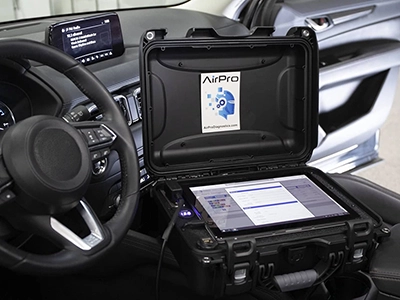
For a PDR shop, the practical impact is direct. When a hail job brings in a windshield replacement, the windshield is already coming out and going back in. Mounting Auggie Air on the replacement glass takes minutes. There is no need to clear space in the bay, set up target boards, or wait for the right conditions. Your technician connects the AirPro device, a US-based Brand Specialist joins the session and guides the calibration, and the documentation is generated before the car leaves.
Auggie Air is a targeting device, not a calibration device. It works in concert with the AirPro Assisted glass calibration, where a Brand Specialist leads the procedure remotely. Your shop does not need to become a calibration expert. You connect the device. You mount Auggie Air. The Brand Specialist does the rest.
See How It Works in 3 Simple Steps
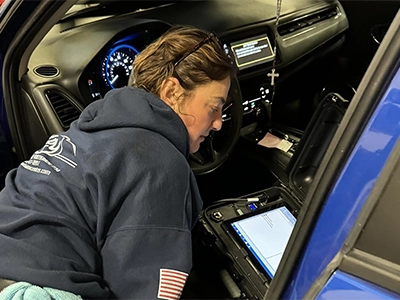
Connect
Your technician connects the AirPro device to the vehicle in your bay. One click opens an assist when the work calls for one.
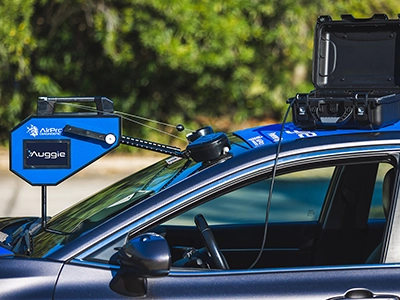
Scan
Pre-scans, Diagnostic Scans, and Completion Scans run on the AirPro device with brand-authenticated tooling. A US-based Brand Specialist with in-depth experience on the brand joins live when the procedure calls for an expert in the loop.
Document
Documentation generates automatically against the OEM position statement, timestamped, and aligned to DRP audit requirements.
AirPro does not have direct relationships or agreements with insurance companies. We support all our customers in meeting their DRP compliance and documentation requirements, and our customers usually participate in DRP programs, including State Farm, Allstate, GEICO, Progressive, and USAA.
Two Ways to Add ADAS Calibration to Your Shop
AirPro Flex
Starting at $349/mo
Your technicians initiate the scans and run the glass calibration with Auggie Air, and a US-based Brand Specialist is available on demand when they need expert backup. Built for shops ready to lead the work with expert support a click away.
AirPro Assist
Starting at $525/mo
A US-based Brand Specialist guides every glass calibration from start to finish, handling codes, calibration requirements, and documentation. Built for shops that want fully-guided coverage on every job with no ADAS expertise required.
Not sure which fits? If your technicians are ready to initiate scans themselves and want expert backup available when they need it, start with Flex. If you want a Brand Specialist guiding every glass calibration from day one with no ADAS knowledge required from your shop, start with Assist. An AirPro Representative will match you to the right plan based on your scan volume.
US-Based Brand Specialists Are One Click Away
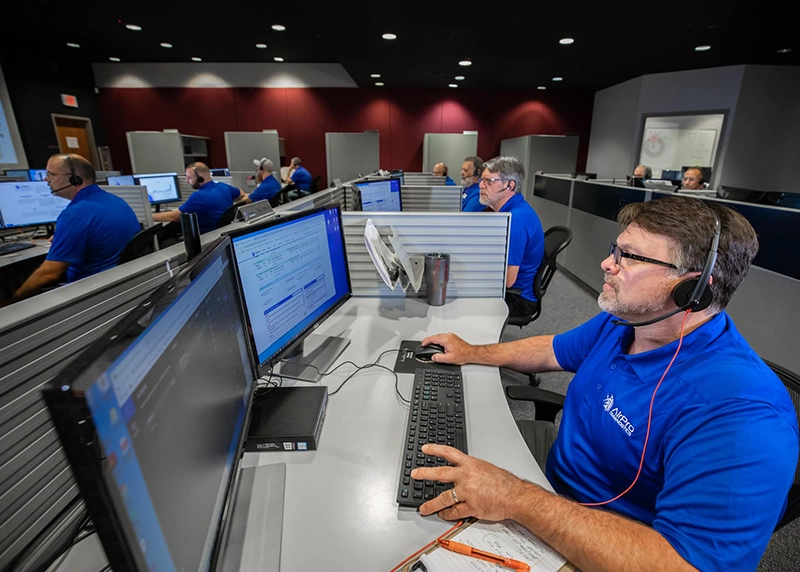
This is not a remote call center. AirPro’s technicians are US-based Brand Specialists who perform ADAS calibrations across every major OEM platform daily. They know the vehicles, the procedures, and the documentation requirements, because that is all they do.
On AirPro Flex, a Brand Specialist is available on demand when your technician hits a wall. On AirPro Assist, a Brand Specialist is live on every scan, guiding your team through codes, calibration requirements, and documentation from start to finish. No ADAS experience required from anyone on your floor.
No script. No call tree. No transfer to a supervisor. The Brand Specialist on the line is the one with hands-on, daily experience on the brand in front of you.
What You Get With AirPro
AirPro Device, included free
No upfront hardware costs. Ships to your shop, ready on day one.
Auggie Air, the patented mobile digital targeting device
Fully wireless, no floor targets, works indoors or outdoors. Mount it on the windshield and the calibration begins. See the Auggie Air pricing page for details.
AirPro Assisted glass calibration
Specialist-led, not self-guided. A Brand Specialist handles the procedure remotely while your tech supports in the bay.
Self-Service Pre-Scans (Flex) or Assisted Inspections (Assist)
Know what the vehicle requires before work starts, every time.
Documentation generated automatically
Timestamped, VIN-specific, aligned to the OEM position statement. Attaches directly to the insurance claim record.
US-based Brand Specialists
On demand with Flex, live on every scan with Assist. Brand-specific expertise on every job.
OEM-licensed software, available on request
When the work calls for it. No subscriptions or licensing for your shop to manage.
98% vehicle coverage
ICE, hybrid, PHEV, and BEV. Every major platform your hail bays see.
Ready to Explore Your Options?
AirPro Flex
Starting at $349/mo
Tech-led scanning and glass calibration with on-demand Brand Specialist backup.
AirPro Assist
Starting at $525/mo
A Brand Specialist guiding every glass calibration. Full OEM documentation on every job.
Other Industries We Serve

Frequently Asked Questions
If there is no warning light, is a calibration still required after a windshield replacement?
Yes. Several OEM position statements are explicit that a camera can be out of calibration after a windshield replacement without generating a fault code or illuminating a warning light. The vehicle drives and handles normally. The forward-facing camera does not perform as designed. Returning a vehicle in that condition creates liability for the shop that performed the triggering work, and leaves the insurance claim record without the documentation it requires.
Does the ADAS calibration belong on the insurance claim?
Yes. When a windshield replacement on an ADAS-equipped vehicle is covered by an insurance claim, the required camera recalibration is a documented, billable line item on that repair. AirPro generates the calibration documentation automatically, timestamped and VIN-specific, formatted to support the claim record. Insurers operating under TPA and DRP programs increasingly require this documentation as part of the completed repair.
Does a hail or dent job always require an ADAS calibration?
Not always, but frequently. Hail repair that includes a windshield replacement requires a forward-facing camera recalibration on most ADAS-equipped vehicles built since 2016. Roof, pillar, and panel work near radar and camera mounts can also trigger a requirement. A US-based Brand Specialist confirms the specific requirement against OEM service information for the VIN before the work runs.
What is Auggie Air, and why is it suited to PDR and hail work?
Auggie Air is AirPro’s patented mobile forward-facing camera calibration targeting device. It mounts directly on the vehicle’s windshield and renders a precise digital version of the required ADAS calibration target. No floor-mounted target boards are needed, no 250 square feet of clear indoor space is required, and no measurements are taken. Auggie Air is fully wireless and works indoors or outdoors, on any surface, including parking lots, hail restoration tents, and the field. Setup takes minutes. It is engineered specifically for the environments where PDR and glass work happen, and it has no equivalent in the marketplace.
What is the difference between AirPro Flex and AirPro Assist?
AirPro Flex (starting at $349/mo) is tech-led: your technicians initiate self-service scans, and a US-based Brand Specialist is available on demand when they need expert guidance. AirPro Assist (starting at $525/mo) puts a Brand Specialist live on every scan, guiding your team through codes, calibration requirements, and documentation from start to finish. No ADAS knowledge is required from your shop. If your technicians are ready to run scans, start with Flex. If you want a specialist guiding every glass calibration from day one, start with Assist.
Can my shop do the glass calibration in-house instead of subletting it?
Yes. AirPro runs it as an Assisted glass calibration: a US-based Brand Specialist takes over the AirPro device remotely and guides your technician through the procedure, with Auggie Air providing the targeting on the windshield. Your shop does not need to become a calibration expert. You connect the device. You mount Auggie Air. The Specialist does the rest.
Does my shop need a separate scan tool?
No. The AirPro device is included and handles scanning, diagnostics, calibrations, and module programming. AirPro covers 98% of all vehicles on the road, including ICE, hybrid, PHEV, and battery electric.