
By Josh McFarlin, Chief Operating Officer, AirPro Diagnostics
A recalibration that completes is not the same as a recalibration that is right.
Our industry has largely settled for the first. The tool reports finished, the vehicle leaves, and the job is treated as done. But completion was never the standard. The standard is the manufacturer’s specification for that vehicle, and whether you actually met it comes down to one thing: how closely the process you followed matches the process the manufacturer specified.
That is the whole argument, and it is a chain. The closer your process sits to the OEM process, the less human error enters it. The less human error enters it, the closer your result lands to what the manufacturer intended. Everything else we argue about in this industry sits downstream of that.

Start where everyone already agrees
Every credible recalibration starts in the same place. The manufacturer has a procedure for that specific vehicle, and that procedure is the standard. Nobody in this industry seriously argues otherwise.
Where we differ is what happens between that document and the car.
What sits between the specification and the vehicle
Walk through a conventional recalibration honestly. Somebody reads the procedure. Somebody identifies the vehicle and works out which target it calls for. Somebody establishes the centerline, often with a string and a plumb bob and a chalk mark. Somebody sets the height, paces out the distance, squares the target and checks it.
Every one of those is a translation. A human taking what the manufacturer specified and converting it into something physical at the vehicle. And every translation is a place to be wrong.
I do this at events. Hand two experienced technicians a tape measure and ask each of them to mark out three thousand millimeters. You will get two marks. Not because either of them is careless, and not because either lacks training. Because that is what happens when a person performs a measurement by hand.
We do not have a diligence problem in this industry. We have a translation problem, and we have never really counted how many translations sit inside a single job.
The result should not depend on who drew the job
Here is the test I would apply to any recalibration process. If your two most experienced technicians and your two newest run the same job on the same vehicle, how far apart are the results?
In most shops the honest answer is further apart than anyone wants to say out loud. And we have normalized it. We call it a training problem and we invest accordingly.
Training matters. But a process that only produces a correct result in the hands of your best technician is not a reliable process, it is a dependency. The variation is not coming from carelessness. It is coming from a process that asks a person to reproduce a manufacturer’s specification by hand, and then quietly relies on their judgment to land close enough.
Close enough is not the standard. The specification is the standard.
When the process itself carries the manufacturer’s requirement all the way to the vehicle, the differences between technicians stop deciding the outcome. Your newest technician produces the same result as your most experienced one, because neither is being asked to translate anything. That is not a reduction of the technician’s skill. It releases it for the parts of the job that genuinely need judgment.
What the controlled environment was actually doing
The dedicated recalibration center earned its reputation honestly. A level floor, controlled lighting, known distances, space to work. None of that was superstition, and I am not dismissing it.
But look carefully at what it controls. It controls the conditions around the measurement. It does not remove a single human step from the process. The technician still reads the procedure, still selects the target, still finds the centerline, still places and squares everything by hand. A controlled room does not eliminate human error. It makes the surroundings consistent while leaving the largest source of variation completely untouched.
The uncomfortable question
So let me put it to the industry directly. Was environment ever actually a guarantee of quality?
I do not believe it was. It was a guarantee of consistency in one set of variables, and we let it stand in for something much larger that it never covered. A controlled room tells you the floor was level and the lighting was even. It tells you nothing about whether the target ended up where the manufacturer said it should.
We have spent years, and in some cases a considerable amount of capital, treating the room as the proof. If the room was never the proof, then much of what we have used to judge each other’s work has been a proxy for the thing we actually care about, and not an especially good one.
So what is the guarantee?
Fidelity to the OEM process, measured by how little of it depends on a person getting it right by hand.
That means the process should identify the vehicle, determine what the manufacturer requires for it, and deliver that to the car without anyone retyping it, converting it, or pacing it out. Not an approximation of the procedure. The procedure itself, executed with fewer opportunities to drift away from it.
I want to be precise here, because this is where the conversation usually goes wrong. Automating those steps is not a way around the OEM process. It is the opposite. It is how you follow the manufacturer’s requirements more exactly than a person can by hand, on every job, regardless of who is holding the tool. The process is the foundation. Everything else is built on top of it.
Once that is true, the environment argument settles itself. A recalibration performed to specification with the human error engineered out of it is not a better recalibration than one performed carefully by hand in a purpose-built room. Done right, both meet the same specification. It is a more consistent one, because it does not depend on everything going right by hand, and consistency across every job is what a shop is actually buying.
Then prove it
Removing error is half of the answer. The other half is being able to show it.
A recalibration record should show what the manufacturer required for that vehicle, that the required conditions were confirmed rather than assumed, that the procedure was followed, and what the as-delivered result was. It should be readable by an insurer without a phone call, and by the next shop to open that windshield. And it should look the same whether the work happened in a purpose-built center, a two-bay glass shop, or a customer’s driveway.
That is a harder standard than the one we use now, and it is harder for everyone, us included. It is also the only one that judges the work rather than the address.
There is a practical edge to this that gets overlooked. A meaningful number of vehicles arrive for recalibration carrying pre-existing issues or repair deficiencies that will not support a proper recalibration to OEM standard. My honest view is that the number is high enough that any shop working without documentation is carrying risk it has never priced. Evidence protects the technician at least as much as it protects the motorist. When a vehicle turns up in a condition that will not support a recalibration to specification, the record of that fact is the shop’s defense, not its paperwork burden.
Where this leaves us
None of this is settled, and I do not expect this industry to agree with me on all of it. The disagreement is the useful part. But I would rather we argued about how much human error we have removed from the process than keep using the room as a substitute for the answer. The shops that win the next decade will not be the ones with the best floor. They will be the ones whose process follows the manufacturer’s exactly, on every job, no matter who is running it, and who can show their work.
Book a live demo at Auto Glass Week
See it in practice. AirPro is at Booth #750 at Auto Glass Week in San Antonio, running live recalibrations across all three days. Select the vehicle and Auggie Air determines what the manufacturer requires and renders the target to that specification, with TruCenter establishing the centerline, so the manual steps come out of the job rather than the standard. Bring the hardest question you have.
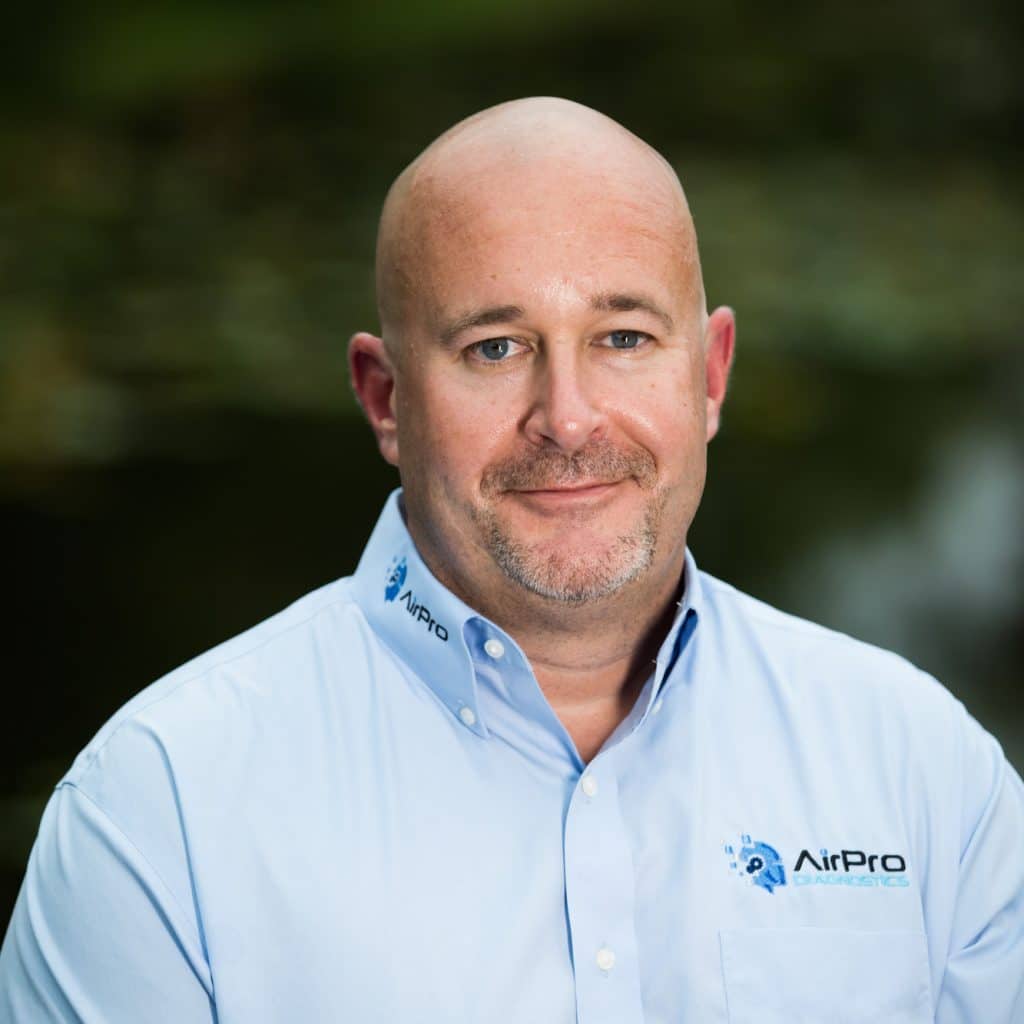
Josh McFarlin, Chief Operating Officer, AirPro Diagnostics
Josh McFarlin is Chief Operating Officer at AirPro Diagnostics, where he brings more than 25 years of automotive experience spanning dealership technician, Ford OE Service Engineer, and industry training leadership. A Ford Senior Master Technician with an MBA, Josh previously served as Director of Curriculum and Product Development at I-CAR, shaping the training that collision repair professionals rely on nationwide. When he’s not working on the future of ADAS diagnostics and calibration, he’s restoring the 1965 Mustang he’s been rebuilding for the last 20 years.